


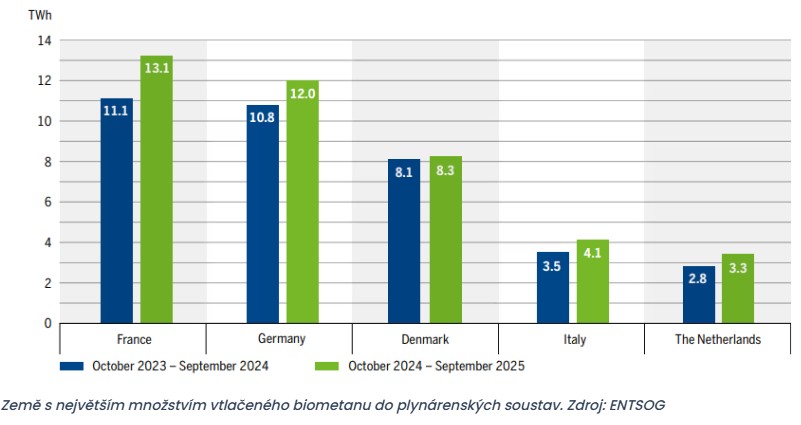
The amount of biomethane injected into the gas grids of European Union Member States increased by more than 5 TWh in the last gas year (October 2024 – September 2025), reaching 43.2 TWh. As part of the REPowerEU initiative, the European Union aims to increase total biomethane production to 35 bcm by 2030, corresponding to approximately 350 TWh. The current market volume therefore represents roughly one seventh of the target set for 2030.
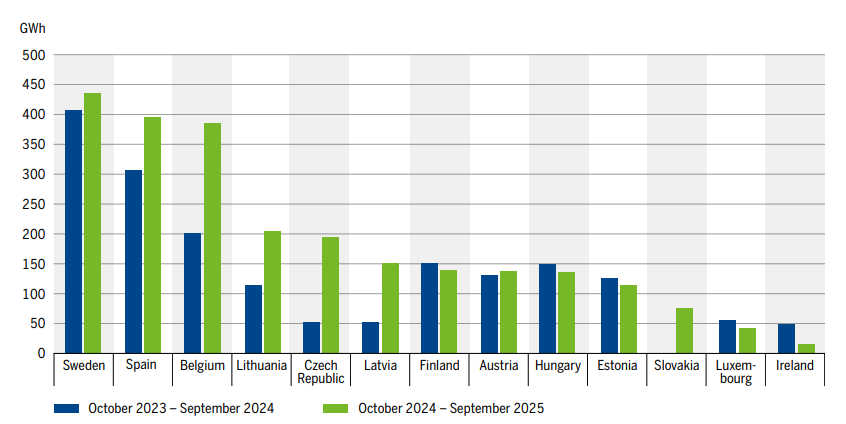
France is currently the largest producer, with 13.1 TWh of biomethane injected into the grid, representing a year-on-year increase of 2 TWh. The second-largest market was Germany with 12 TWh (+1.2 TWh year-on-year), followed by Denmark (8.3 TWh), Italy (4.1 TWh), and the Netherlands (3.3 TWh). Among countries with annual production below 1 TWh, Sweden, Spain, and Belgium are the leading markets. However, one of the fastest-growing markets is the Czech Republic, where biomethane injection increased to almost four times the previous gas year’s level, reaching a total volume of 200 GWh.
According to statistics recently published by the Czech market operator OTE, a.s., the number of Guarantees of Origin issued for biomethane increased by 194% year-on-year last year, reaching almost 171,000 certificates. The number of Guarantees of Origin for biomethane that were cancelled for consumption increased by 388%, reaching almost 119,000 certificates. One Guarantee of Origin corresponds to 1 MWh of delivered energy.
In addition to biomethane injection, the European Network of Transmission System Operators for Gas (ENTSOG) also reported data on hydrogen injected into gas networks. In the case of hydrogen, the injected volume decreased from 3 GWh to 1 GWh, with Germany being the only country where green hydrogen was injected into the gas grid.